 Becky McClellan Creative
Smith European Adventure: Germany
Posted on June 4, 2013
We woke up at 5:00 a.m. Paris time. Having only been in Europe for three days, we were still fighting the recoil of our overstretched internal sleep clocks, and the 4:45 sunrises weren’t helping much. Whether it was from the sheer anticipation of the next leg of our journey or the copious amounts of opaque French coffee we had collectively drank over the previous 72 hours, we were wide awake and ready to drag our heavy, weathered suitcases and matching eyelids onto the train that would take us across the border to the land of lebkuchen. We were Germany-bound.
It is a short four-hour train ride from Paris to Frankfurt via the ICE high-speed rail. The scenery alone is worth the trip, but the convenience of rail travel really validates the proverbial ticket. We arrived at our platform twenty minutes before departure and boarded the train without once having to remove our shoes, place electronic devices in their own bin, or be microwaved like Hot Pockets in a body scanner. Assisted by the multinational crew who, together, knew just enough of several languages to be dangerous, we found our spacious seats and settled in for a fresh breakfast feast of cheese, baguettes, and pain au chocolat, that Becky had previously stuffed into her purse and smuggled aboard. We gawked at the countryside and watched as the slate grey chateaus slid by us, eventually replaced with the vibrant orange tile roofs and hilly farms of southern Germany.
A little before noon, we arrived at Frankfurt’s palatial central train station. Handling an average of over 600 trains per day, it is the busiest train station in Germany, which meant there was plenty to occupy us during the hour connection we had. We grabbed two cups of fresh coffee and huddled around a counter to watch as the choppy waves of commuters, panhandlers and vacationers rolled in and out. Before long, our connecting train had arrived and we were ready to make the final 75-mile leg down to Würzburg.
Würzburg is a sleepy city in the heart of Franconia, Germany’s wine country. With Bronze Age roots, it was officially founded in 704 and has been the site of many struggles for power over the past 1,300 years. It is safe, walkable and full of friendly locals who all represent the city’s rich history. I was fortunate enough to live and study here back in 2004, so I was excited to share the experience with Becky, however abbreviated it might be. There is so much to see and do in Würzburg, and we only had 36 hours. Despite both showing signs of impending head colds, we hit the cobblestone running and didn’t look back.
We arrived at the Würzburger Hof Hotel in the early afternoon to learn that our reservation had been selected for an upgrade to a fancy suite with a private balcony, view of the city from every window and multiple paintings of Audrey Hepburn. The hotel had even placed individually wrapped Milka cookies around the room for us to discover. Were Becky and I not already married, I’m confident she would have thought this was all a clever set up for a proposal. Without dwelling on our fancy dwelling, we unloaded our bags and headed out on the town.
We started with a quick tour of the city’s historic downtown area. The entire city was annihilated by the British during a 1945 bombing campaign that occurred only weeks before the effective end of World War II in Europe. Over the past 67 years, it has slowly been restored to it’s pre-war condition. After an outdoor lunch consisting of homemade käsespätzle and beers from the 370-year-old local brewery, Würzburger Hofbräu, we went on a tour of the Residenz, a Baroque palace that features the world’s largest ceiling fresco. After that, we grabbed a few bottles of water to prepare for our evening adventure to climb the steps of the Stationsweg to the pilgrimage chapel that sits atop a mountain on the banks of the Main, followed by dinner at the nearby Nikolaushof, a winegarten with an unmatched view of the entire city. As is often the case with restaurants at the tops of mountains, however, the hours of business listed on this restaurant’s website were what some hungry mountaineers might consider inadequately detailed. We reached the locked gates of the restaurant to learn that we had visited on the one day of the week that they were closed.
We wandered back into town and slid into the first restaurant we could find — the Uni Cafe, a happening college place so hip that every table was reserved for folks with many more accent marks in their names than we mere Smiths could offer. The management was kind enough to offer us a modest corner table in their upstairs dining room with the other riff-raff that had wandered in after having not paid enough attention to the hours on the Nikolaushof’s website — but only for 45 minutes, as they were expecting a rather large party of aspiring minstrels from the local music academy. Our empty stomachs told us to go for it. So, for 45 minutes, we sat at our table, which happened to feature the world’s largest wall fresco containing the likenesses of both Einstein and Woody Allen. We dined on goulash and applesauce-filled crepes until the manager approached us to casually remind us that our time was up by taking away our plates and any remaining utensils. At that point, we thought it best to retire for the evening.
The next day, we got a fresh start headed to the town square to meet up with friends. Our friend Amy and her mom had traveled to Würzburg for the day with Amy’s grandfather, who was nice enough to treat us all to a lunch consisting of the best of the wurst. Becky had her first currywurst and loved it. I had a quartet of Nürnberger bratwurst in pickled vegetable soup called a Blaue Zipfel. I may or may not have ordered it because of the name and because I saw that it contained vinegar.
After lunch, Becky and I set out on another hike. This time we were headed up to the Marienberg Fortress, a castle that sits on the mountains overlooking Würzburg. The paths up the mountain lead visitors through serene gardens, medieval tunnels, and hillside vineyards. The castle features a small cafe and gift shop, most likely not part of the original blueprints. The cafe has an outdoor dining area that gave us a great view of the outlying areas of the city and the many grape vines that cover nearly every hill.
We ended our afternoon trek with a stroll through the palace gardens at the Residenz and made a quick visit to the Kupsch grocery store where I used to purchase supplies for the infamous miniature banana sandwiches that had sustained me during my time living in Würzburg. Our last evening in town, we walked back down to the city square for dinner at a cafe outside the historic city hall. We enjoyed more wursts with fresh bread, sauerkraut and Franconian Silvaner wine. On our walk back to the hotel, Becky treated me to a few scoops of Waldmeister gelato. After surveying the assorted rainbow of flavors behind the glass, Becky, in perhaps an unconventional move fueled by her recent introduction to Nutella in Paris, came up a chocolate-hazlenut hybrid. The man behind the counter was more than happy to oblige.
We awoke the next morning before dawn. We had a six o’clock train and we still needed to check out of the hotel. We quickly gathered our belongings and any remaining Milka cookies and headed downstairs. The night clerk who checked us out bore a striking resemblance to a young Charles Nelson Reilly and showered us with more candy before sending us on our way.
The final stop on our Franco-German holiday was Berlin — a quick 5-hour trip on the ICE train that included a jaunt through a massive wind farm. We pulled into Berlin’s busy central train station around 11 o’clock. Instead of taking a cab to our hotel, we had decided to utilize Berlin’s extensive network of public transportation. There are no turnstiles or retractable doors in Berlin’s metro stations. You simply buy a ticket and hop on. Everything runs on the honor system. Everything, that is, except for the ticket kiosks themselves, which only accept two types of payment: coins and every credit card except for the ones we carried.
Becky watched our luggage while I set out to get some change. My mini crusade around the station turned up nothing. None of the stores were willing to break a five, likely hoarding all of their coinage for projected future metro ticket purchases of their own. Eventually a security guard was willing to point me in the direction of the parking garage, where I found an old change machine wedged in a stairwell between a parking pass validator and two cigarette machines. After that it was just a few stops, a couple of transfers, a luggage-dragging caravan across Potsdamer Platz and then a few more stops till we were at our hotel.
Efficiency is widespread in Europe, and our hotel was no exception. Our room was tucked into the corner of a corner of the building. It featured a bed and side tables without all those unnecessary legs, free internet that would turn itself like an erratic motion activated sink at an interstate rest stop. Even the electricity to the room had to be re-activated anytime we left and returned. Needless to say, we spent a good deal of time outside the hotel exploring the city.
The erratic weather had put a kibosh on any existing plans we had made, so we pooled all three days worth of outings and made a go at it anytime the downpours showed signs of stopping. We visited Checkpoint Charlie, where Becky had her photo taken with pair of Germans dressed as American soldiers. From there we traced the path of the former Berlin Wall, which is now commemorated in a narrow cobblestone strip that cuts through the city where the wall once divided the east from the west. There is also a section of the wall still standing in front of the site of the former Gestapo headquarters. Not far from there, we found an old 1970s photo booth that was still in working condition. We had to duck in to check it out. Five minutes later, we had a strip of four black and white snapshots complete with the moist odor of their recent stop bath.
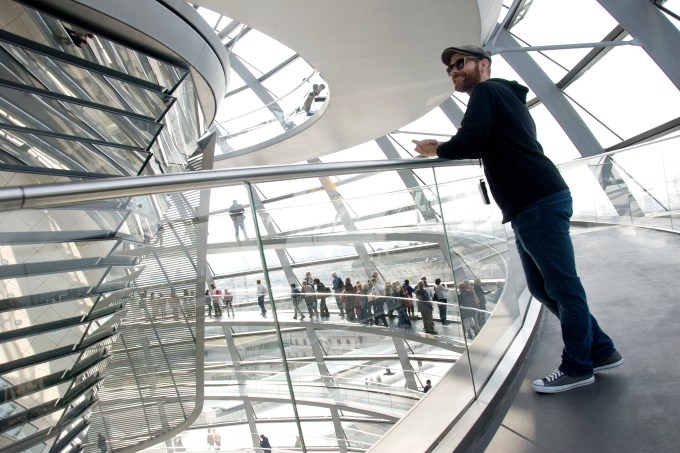
We visited the innovative glass dome that sits atop the Reichstag building and provides a 360-degree panoramic view of the entire city. We passed through the massive Brandenburg gate and explored the feeling of somber alienation between the 2,711 concrete pillars of the Holocaust Memorial. We admired the bricolage of artifacts as we walked across Museum Island to Alexanderplatz, home of the iconic Fernsehturm. We even took a stroll across the patterned stone at Gendarmenmarkt, which is likely most famous for being the plaza that Franka Potente runs across in Run Lola Run. I’m told there are also a few cathedrals and a concert house around there as well.
Our culinary adventures continued in Berlin as well. For three days, we wursted and strudeled across the bear city, stopping not once but twice at a place called Maximilian’s, a Bavarian themed restaurant that might be the German analog to a Cracker Barrel. Near our hotel, we learned all about the ins and outs of currywurst at the Deutsches Currywurst Museum. That’s right; there is an entire museum devoted to currywurst. I am hoping to hear news of a wing showcasing the döner opening in the near future. We shared unfiltered wheat beers and radlers. We even had a few of the obligatory Berliner Weiße, a north German sour beer that has been flavored with raspberry or woodruff and served with the world’s least useful straw.
By Friday night, our 8-day European holiday had come to an end. We had filled our stomachs and camera rolls with memories, and we were grateful for every last drop and bite of the experiences we had shared. We turned out the lights, our feet aching for familiar sidewalks; our minds clouded with the remnants of multiple broken languages, we shut our eyes and dreamt of home.


 Becky McClellan Creative